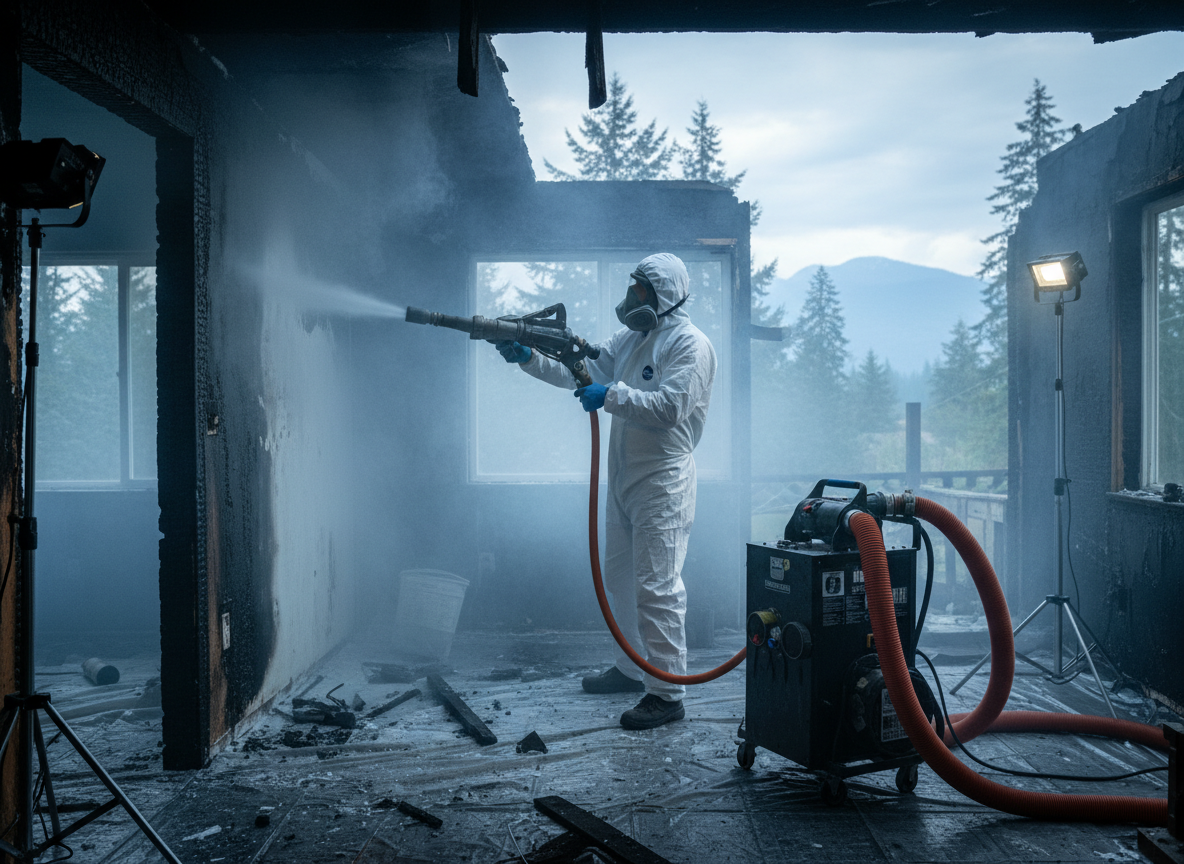
Smoke remediation in South Prairie homes often involves penetrating odors in older single-story ranch houses common along WA-162. Marine west coast winters bring persistent humidity that traps soot in drywall, insulation, and attic spaces, requiring more aggressive air scrubbing and thermal fogging than in drier climates. Technicians working out of 117 WA-162 routinely check crawl spaces and wall cavities where smoke travels upward from basement or garage fires, using moisture meters to confirm no hidden water from suppression efforts remains before sealing surfaces.
Near Enumclaw and Buckley, many properties sit on sloped terrain with cedar siding that absorbs smoke particles deeply during wet winters. Remediation crews focus on removing and replacing affected insulation while treating HVAC systems to prevent redistribution of residues through ducts. Homeowners in these areas frequently overlook how prolonged damp conditions can cause smoke to bond with wood framing, making simple ozone treatments ineffective without first addressing moisture levels in Pierce County homes.
The process accounts for local building practices where many South Prairie residences have limited attic access and older electrical systems that complicate equipment placement. After initial containment, HEPA filtration runs continuously to capture fine particulates stirred up by the area's frequent rain and wind. Final clearance testing ensures no lingering odors remain before reconstruction begins, especially important when families plan to return quickly during the shorter daylight hours of winter.
Technician insight
In South Prairie, the thing that catches most people out with smoke remediation is how the wet winters keep humidity high enough that soot bonds to cedar framing and insulation far longer than in drier spots like Buckley. Homeowners often try DIY sprays first, which just push the residue deeper into the older ranch houses along WA-162 and make the job take twice as long once we arrive.
Garage fire smoke in a WA-162 ranch house
Smoke from a garage electrical fire migrated into the living areas of a single-story home near South Prairie. We found heavy soot in the HVAC ducts and attic insulation that the damp winter air had kept from drying. After removing affected materials and running continuous filtration, the home passed clearance testing with no remaining odors.
How it works
- 1
Initial Assessment
Inspect all affected rooms, attics, and HVAC systems to map smoke migration paths in the home.
- 2
Containment and Removal
Set up barriers and remove porous materials like carpet and insulation that hold soot in South Prairie homes.
- 3
Cleaning and Treatment
Apply specialized cleaners to hard surfaces and use air scrubbers to pull remaining particles from the air.
- 4
Odor Neutralization
Deploy thermal fogging or hydroxyl generators to reach hidden areas where wet winter humidity has trapped residues.
- 5
Final Verification
Test air quality and surfaces before allowing re-entry and reconstruction.
Pricing
Pricing varies by square footage affected, number of rooms, and whether HVAC cleaning is required; 24/7 dispatch from our South Prairie location keeps response costs predictable.