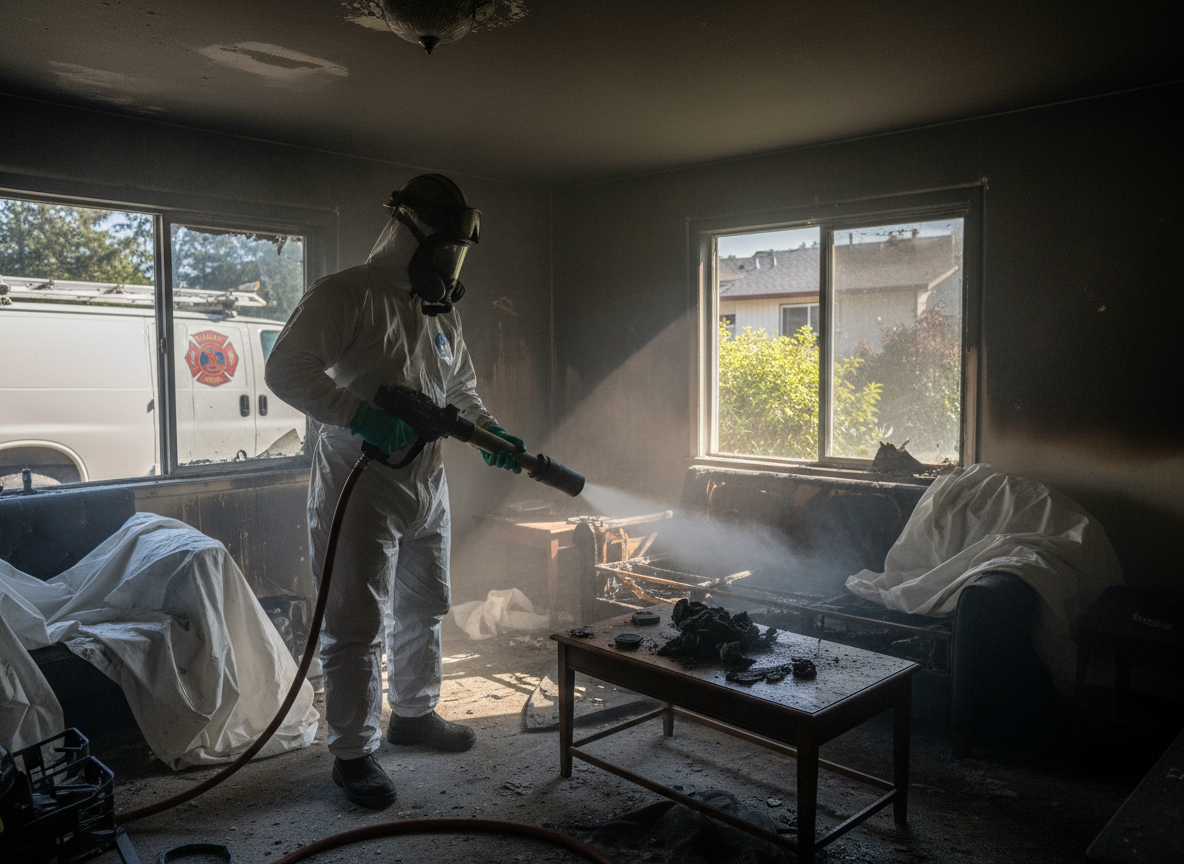
Smoke from structure fires in South Prairie settles into the porous wood framing and older plaster found in many Pierce County homes built before the 1970s. Marine west coast winters bring persistent moisture that drives residues deeper into attics, crawl spaces, and wall cavities, making simple airing-out ineffective. Technicians must map airflow paths through these tight, uninsulated spaces and treat both visible char and invisible particulates that continue off-gassing for months.
Ozone and hydroxyl treatments require careful containment because the same damp air that traps odors can also carry treated particles into unaffected rooms. In neighborhoods near Buckley and Enumclaw, properties often sit on sloped lots where water migrates toward foundations, so technicians seal lower levels first to prevent re-soiling of cleaned surfaces. HVAC systems in these homes frequently lack modern filtration, allowing odors to recirculate through shared ductwork between main houses and detached garages.
Homeowners sometimes attempt DIY masking with sprays or candles, but these only cover the problem until humidity spikes again. Professional removal focuses on source elimination using emulsifiers matched to the specific fuel type, followed by sealing porous surfaces with odor-blocking primers rated for high-moisture environments. Follow-up checks after the first wet season confirm whether residues have re-emerged in areas that stayed damp during initial treatment.
Technician insight
In South Prairie, the thing that catches most people out with Odor removal after fire is how wet winters let smoke residues bond into the uninsulated attics and crawl spaces typical of Pierce County homes near Buckley and Enumclaw, so odors return the first time humidity rises unless those hidden areas are treated.
Smoke in South Prairie Attic After Kitchen Fire
A kitchen fire in a 1960s South Prairie home sent smoke upward through wall cavities into the attic. Inspection showed residues had settled into older insulation and roof sheathing during the damp season. We performed source cleaning, ran targeted air treatment, and sealed surfaces. Odors stayed gone through the following winter rains.
How it works
- 1
Initial Assessment
Inspect all affected rooms, attics, and crawl spaces to identify smoke migration routes through the home's construction.
- 2
Source Removal
Clean charred materials and apply emulsifiers to break down residues embedded in wood, plaster, and insulation.
- 3
Air Treatment
Deploy containment barriers and run ozone or hydroxyl generators to neutralize remaining airborne and surface odors.
- 4
Sealing and Verification
Apply moisture-rated primers to treated surfaces and conduct post-treatment odor checks after a full weather cycle.
Pricing
Cost depends on square footage affected, depth of smoke penetration into older construction, and whether HVAC cleaning is required.